
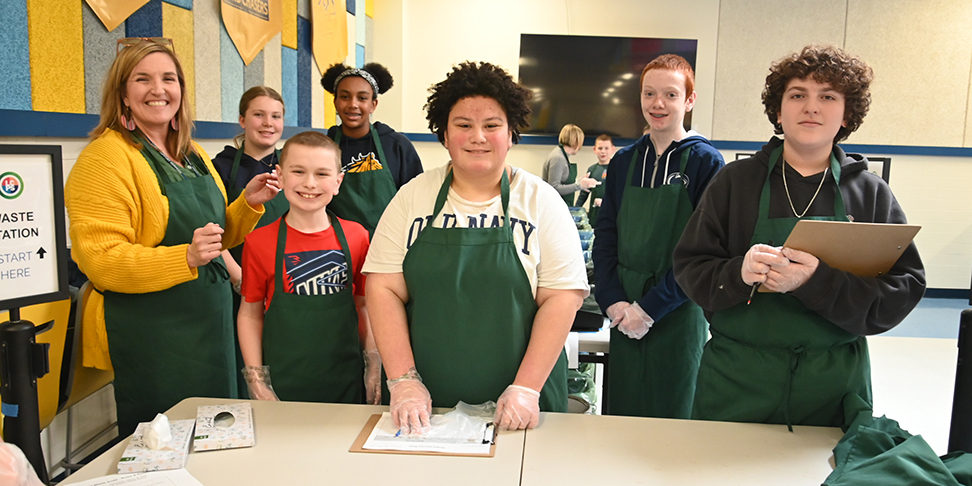
Members of the J.L. Simpson Middle School Student Council donned green aprons and pulled on plastic gloves as they gathered in the corner of the school cafeteria during a recent lunch period, ready for an unusual assignment. During Simpson’s three lunch periods, their mission was to collect, sort, and measure all the food thrown away.
Students at Watson Mountain Middle and Blue Ridge Middle also participated in food‑waste audits. At each school, students collected and weighed every item discarded in the cafeteria to better understand how much waste is generated during lunch and what types of waste are generated.
This activity is part of each school’s Green Team work. Coordinated by the LCPS Office of Sustainability, Green Teams are voluntary, school‑based groups that take on projects to promote sustainable practices. These teams are led by school-based Green Team Leads who collaborate with students and staff to explore ideas and identify projects that strengthen sustainability across the school. Researching and reducing food waste is a great topic for Green Teams and students to explore, given its interactive nature and its relevance to everyone's daily lives.
“Food waste is a great topic for students to explore because it’s super visible to them. They interact with food every day! Reducing food waste is also an effort in which they can easily see tangible and near-term results. Food waste audits allow us to use the cafeteria as our laboratory. Students learn more about what kinds of food waste are most common in their school and then prioritize strategies for bringing about change.” said Clark Seipt, director of the Office of Sustainability.
To gather accurate data, students sorted cafeteria waste into six categories:
food brought from home
empty bottles and cans
whole fruits
unopened packaged food
food scraps
single‑use plastics
paper products and miscellaneous trash (napkins, trays, food wrappers, snack bags)
Liquids were poured into a separate bucket for measurement.
As the bins filled, students began noticing patterns. One student pointed out the large number of empty beverage bottles and cans. Food scraps were the heaviest category. At that point in the collection process, food scraps weighed in at 25 pounds. Meanwhile, the paper‑products bin – which included the pressed paper trays and food wrappers – had to be emptied six times, even though each load weighed only a few pounds.
While collecting waste, students asked their classmates why they were throwing certain items away. Many said they weren’t hungry or simply didn’t want the food. Others commented on quality. Apples were described as mealy, rolls were unpopular, and banana‑flavored applesauce was widely discarded.
The experience prompted meaningful reflection. One student shared, “It makes me think about how much food people waste.” Another noted that the project made them more aware of what they choose to throw away.
These observations are also incredibly helpful to LCPS School Nutrition Services, whose mission is to provide nutritious food that students will eat and enjoy.
These hands‑on audits give students a tangible look at the scale of food waste while providing valuable baseline data. With this information, students will now work together to design and test strategies to reduce waste in their schools, turning observation into action and awareness into change.