
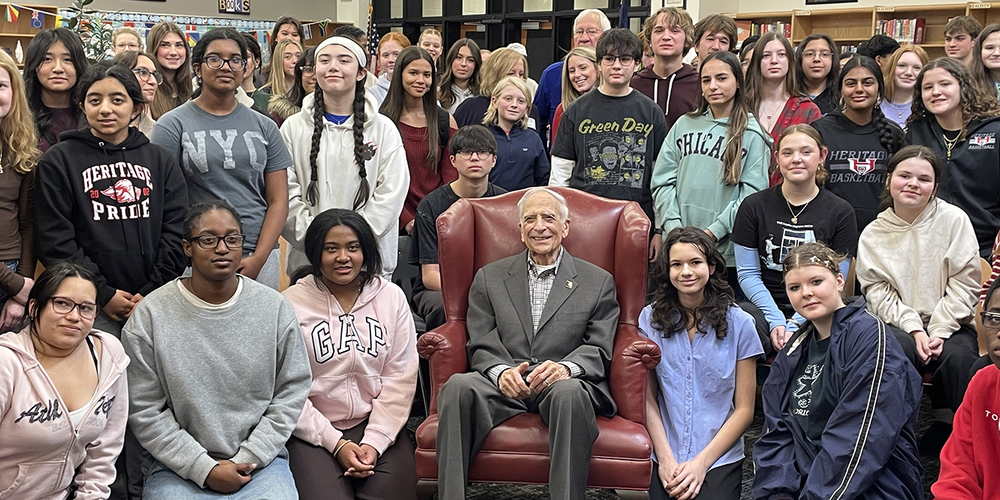
Heritage High School students recently encountered living history when Holocaust survivor Frank Cohn, who turned 100 in August 2025, visited the school to share his life story. Born Franz Cohn in Breslau, Germany (now Wrocław, Poland), he recounted his childhood under the rise of Nazism and the events that ultimately forced his family to flee.
One of the most vivid memories he shared was attending a parade where Hitler greeted the crowd. Standing beside him was his family’s beloved live-in maid, whom he viewed as a second mother. He remembered her excitement at seeing Hitler and his own terror. He recalled that Jews were forbidden to salute Hitler, and even as a child, he feared what might happen if he failed to follow the rules of the new world he was living in.
Mr. Cohn described how he and his mother escaped Germany in 1938, carrying only one suitcase each and ten Deutschmarks. His father had already left for the United States to prepare for their arrival. Frank’s mother was able to purchase first‑class tickets to New York. They arrived in New York on October 30, just days before Kristallnacht, after which it became very difficult for Jews to leave Germany. He reflected on how easily their fate could have changed had he and his mother hesitated, even briefly, about leaving their home and friends.
In America, Franz became Frank, a change that Frank celebrated. He learned English, attended school, and at 18 was drafted into the U.S. Army. He landed on Omaha Beach months after D‑Day, later serving in Belgium and France. When the Army discovered he spoke German, he was trained in military intelligence. His work included assessing captured Nazi officials, securing sensitive sites, and overseeing the shipment of Nazi documents to the U.S. for war‑crimes prosecutions. During his service, he searched for relatives left behind and eventually learned that 11 members of his extended family were murdered in the Holocaust.
The Heritage teachers who coordinated the event said that Mr. Cohn’s visit was an extraordinary opportunity for students to engage with history through the lens of lived experience.
World History teacher Holly Horton emphasized how Mr. Cohn’s testimony turned abstract concepts like antisemitism, discriminatory laws and Kristallnacht into lived reality. “The laws that we analyze in class that were changed by Hitler affected Frank and his family. Thanks to Mr. Cohn’s visit and his testimony, the students can reflect on this experience as we discuss these laws.”
English teacher Nicole Korsen hopes that her students took away from the presentation the power of the personal story. This experience, she shared, connected powerfully with her class’s curriculum on identity and coming‑of‑age narratives. “Hearing Frank talk about his younger years could not have aligned better with some of the issues we discuss…We will discuss the many stories that Frank shared…Reading about someone's experience can be very impactful, but hearing it firsthand is something else entirely.”