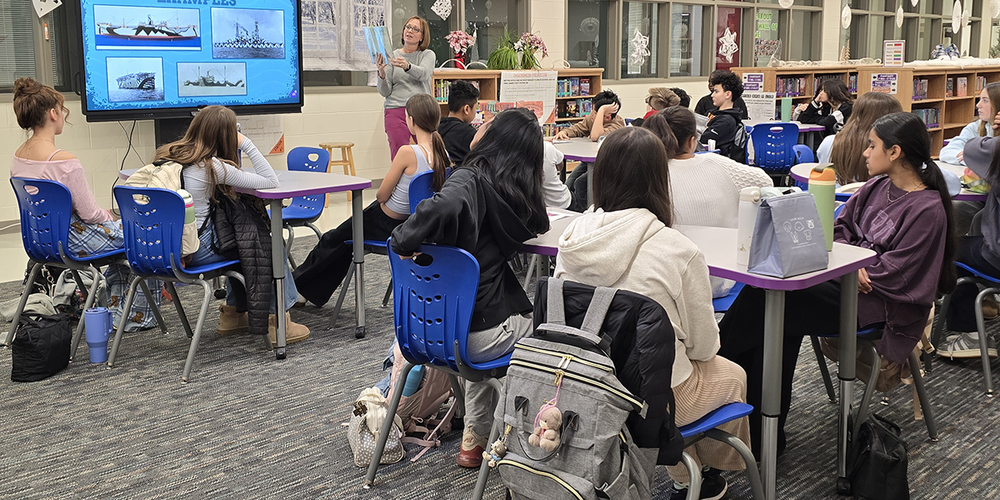
Recently, following a World War I unit, seventh-grade students at Watson Mountain Middle School took part in a library-based extension that connected classroom learning to narrative nonfiction and historical fiction. Students explored stories that highlighted lesser-known aspects of World War I, including the role of knitting and the innovative use of optical-illusion dazzle ships designed to confuse enemy submarines.
For several years, Teacher Librarian, Melissa Larson and Social Science and Global Studies Teacher Douglas Bauer have partnered to create a collaborative learning experience that brings classroom instruction and library learning together in meaningful ways. By intentionally aligning history content with literature and hands-on, student-centered exploration, students move beyond memorizing facts to developing a deeper understanding, empathy and perspective.
This year’s end-of-unit experience also included a unique cross-school connection. Luke, a sophomore from Independence High School joined the seventh-grade students as a volunteer, sharing his knowledge, understanding and genuine enjoyment of knitting. His presence added an authentic, peer-led dimension to the activity, allowing students to see how interests and skills can span grade levels, schools and traditional expectations.
Some of the books students engaged with included Cher Ami, Knit Your Bit, Dazzle Ships and Grace Banker: Hello Girls Answer the Call. Each title offered a different lens into the era, helping students connect historical events with personal stories and broader social impact. This approach allows students to see history not only as a series of events, but as lived experiences that affected real people in complex ways.
Children’s and youth literature plays an important role in enrichment at all grade levels. These books are accessible and engaging, often presenting complex historical ideas in ways that invite reflection and discussion. By pairing core instruction with age-appropriate narrative texts, students are better able to build background knowledge, connect emotionally with content and think critically about the past.
Books such as Knit Your Bit also open the door to conversations about interests, identity and inclusion. The story encourages students to explore activities like knitting without attaching assumptions about who should or should not participate. Even when an activity is attempted but not pursued long-term, the experience supports curiosity, respect and openness to learning.
In addition to its historical relevance, knitting offered social-emotional learning benefits for students. Hands-on activities like knitting support focus, provide a productive outlet for fidgeting and help students enter a state of flow, where attention and engagement are sustained. These moments of calm concentration can be especially valuable during reflective learning experiences, helping students regulate energy while remaining engaged.
“Working closely with the library has significantly increased student engagement in my class,” said Mr. Bauer. “Students are more invested in the content, and thinking more deeply and considering history from multiple perspectives. The collaboration helps them connect facts to human experiences in a way that truly sticks. I have found it also allows students to build empathy for the people who lived through the time periods we study.”
Mrs. Larson added, “Pairing literature with hands-on, creative experiences helps students make personal connections to history while supporting curiosity, focus and a deeper appreciation for how stories bring learning to life. The school library serves as a natural bridge between curriculum and curiosity, offering space, resources and experiences that support both academic growth and well-being as students deepen understanding, explore interests and connect learning across disciplines.”
Looking ahead, the team has mapped out a series of upcoming end-of-unit experiences that will continue to pair historical study with literature and inquiry-based activities. The next library lesson will focus on the Roaring 20s and the Great Depression, followed by a World War II unit highlighting the role of Navajo Code Talkers. Subsequent lessons will explore the Cold War and, later, the Civil Rights Movement, encouraging students to deepen understanding and examine history through multiple perspectives.